Francesco Del Sole
Department of Cultural Heritage, University of Salento, Lecce, Italyhttps://orcid.org/0000-0002-5024-2951
This proposal will analyse the motivations that led intellectuals of the third century B.C. to create the canon of Wonders of the World. It is emblematic that the ancient sources do not speak of the Wonders of one civilisation or another; they speak of the Wonders of the World, making this one of the first examples of interculturality in which the protagonist is Man side by side with his History. In the contemporary world, where reference is made to belong to a common reality gravitating around the Mediterranean, we look for a “global” culture made of images that can express an idea of universality. The wonders of the world could be the key to recomposing under the common denominator of a glorious past, a fragmented reality, such as the Mediterranean one.
1. Introduction
To understand the antiquity of this list, it would be enough to think of one of the seven Wonders: the Colossus of Rhodes, built between 304 and 292 BC and destroyed by an earthquake less than a century later between 227 and 224 BC. Inevitably, the list is drawn up during this period (Fagiolo, 1976; Clayton, Price, 1989; Del Sole, 2019, 2020). The most ancient sources about the Wonders are the De septem orbis spectaculis attributed to Philo from Byzantium (3rd-2nd century B.C.) and the poetic composition of Antipatro da Sidone (2nd century B.C.), The wonder of wonders (Clayton, Price, 1989, pp. 160-164; Pontani, 1980, III, 9, 58).
Both Filone and Antipatro, with their list, have described the masterpieces that the Ancients considered unsurpassable, thus handed down with the concept of Wonders. They are, therefore, the Pyramids of Egypt, the statue of Zeus in the Temple of Olympia, the Colossus of Rhodes, the Mausoleum of Halicarnassus, the Temple of Diana at Ephesus, the Lighthouse of Alexandria, the Walls and Hanging Gardens of Babylon. The Wonders represent those constructions which, because of their grandeur, aspired to the title of absolute uniqueness among all man’s structures and managed to arouse amazement in anyone who admired them. The yardstick used by the Ancients was certainly the technological genius associated with the systematic nature of the materials used for the construction: Pyramids (stone), Walls of Babylon (clay bricks), Temple of Artemis (marble), Mausoleum of Halicarnassus (sculptural decoration in marble), Statue of Zeus (Chryselephantine technique, using gold and ivory), Colossus of Rhodes (bronze) (Mangani, 2006; Meslin, 1988).
As Maria Luisa Madonna writes, this list inherited from Antiquity is transformed, shaped according to new needs (Madonna, 1976). In the Middle Ages, the term Mirabilia, in which it holds itself an aesthetic meaning of the lost ancient buildings, was born (Berti, 2007). A long series of anecdotes, legends and stories that describe the Wonders flourished, mostly highlighting the magical and mysterious character hovered around them and the characters linked to their construction. Each Wonder tends to be transfigured and modified in the popular imagination, swelling in size, mixing with other Wonders and sometimes multiplying (the Walls and Pyramids are conceived according to cosmological numbers; Rome, the eighth Wonder, was the place par excellence of cosmic mystery).
Only the “philology” of Humanism will do justice to the many legends that revolved around them. In the fifteenth century, the archetype tends to return to its original forms, albeit in unusual contexts (such as the evocation of the Temple of Halicarnassus in Hypnerotomachia Poliphili by Francesco Colonna). It was only in the sixteenth century that the canon of Wonders, which has always been mutable, was fixed in the form we know today. This result was achieved thanks to a whole series of engravings on this theme, of which we remember the one designed by Martin Van Heemskerck (1572), which, however, includes as the eighth wonder the Colosseum. Very famous were also Van Aelst print of the late sixteenth century (which includes the Colosseum and eliminates the Pyramids and the Lighthouse) and the Villalpando series (1596) which adds the Palace of Cyrus and the Temple of Solomon. In the seventeenth century, instead, we find the series by Antonio Tempesta (1608) and the literary testimony of Lithgow (1612) (Del Sole, 2019, pp. 54-92).
1.1. Forgotten wonders
It is also interesting to mention the “forgotten wonders”, those which are excluded from the official canon over time. Diodorus Siculus, for example, includes among the Wonders also the great obelisk of Semiramis, considered the first-ever raised in history. The city of Babylon contains in itself many Wonders worthy of being remembered beyond those already mentioned. Among them, ancient historians remember the bridge over the Euphrates, the citadel of Semiramis, its grandiose fortress and the temple of Zeus-Belo. Martial, praising the city of Rome, states that the Colosseum, just built, far surpasses all the seven Wonders of Antiquity. Propertius presses on judging his verses more indestructible than the Pyramids, the tomb of Mausolus or the temple of Zeus at Olympia. The whole city of Rome is a new Babylon, a new “city of Wonders”, full of monuments that aspire to the title (the most popular is the Capitol with its statues and the city walls that are associated with those of Babylon). Other authors, such as Igino or Cassiodoro, look instead to the Persian world, proposing magnificent works such as the Palace of Cyrus in Ecbatana. (Clayton, Price, 1989, pp. 151-156; Del Sole, 2019, pp. 26-27).
The list of Bede the Venerable includes other legendary works, such as the statue of Bellerophon suspended in the air thanks to a sophisticated play of magnets (which, it is said, inspired the Christians to the figure of St. George), the theatre of Heraclea, the Baths of Caracalla (characteristic because the fire on site is perennial) and the altar of Delos. The Egyptian world, besides the Pyramids, is the master in this field as can be seen in Figure 1. Frequent is the mention of the famous Homeric city of Thebes (defined as the “city of a hundred doors”) and of all those labyrinthine structures that have given life to such well-known archetypes. Besides mentioning some canonical Wonders, Lucio Ampelio makes a selection of “Literary Wonders”, i.e. those objects belonging to the great characters of ancient literature. These include Agamemnon’s shield and sword, Marsyas’ skin, Penelope’s cloth, Ulysses’ armour and the bridge built by Medea. He also considers as “wonderful places” those where the same events narrated by the writers took place, such as the mountain from which Sappho threw herself for love.
Some neo-Medieval Wonders are linked to the Christian imagination that tries to appropriate the myth of the “marvellous” with some equally mythical archetypes such as Noah’s Ark (related to the apocalyptic vision of the Middle Ages regarding the destruction of the world in the year 1000, which would later resume Kircher), the Heavenly Jerusalem or the Tower of Babel.
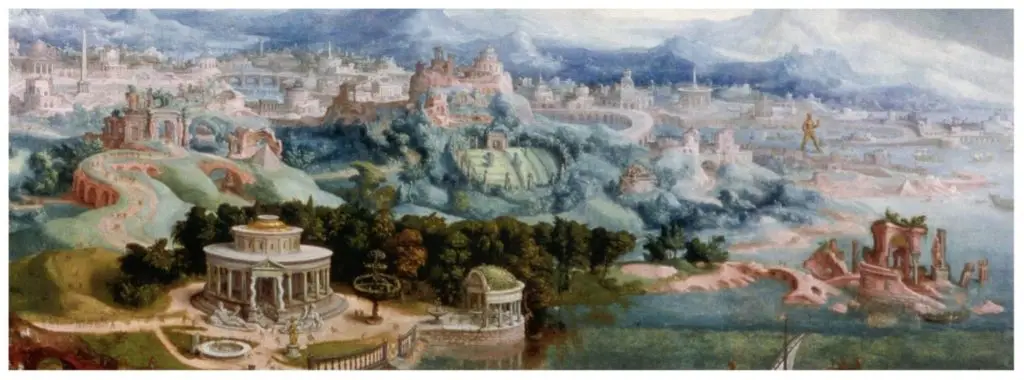
Figure 1. M. van Heemskerck, Panoramic Fantasy with the Abduction of Helen, 1535. The landscape, the protagonist of the painting, is dotted with fantastic reproductions of the wonders of the world. (Source: Walters Art Museum, Baltimore, USA, https://art.thewalters.org/detail/21286)
2. Methods: The Historical Role of the List
Therefore, the Wonders appear as a historical fact, perfect symbols to transmit the memory of ancient history. From a historical point of view, these seven buildings can be much more than just a symbol of artifice. It is as if man in the third century B.C. had looked back and started to sum up ancient history by condensing it into a few symbols, trying to draw a line from the beginning of man to his contemporary age, conceived as a sort of “end of a historical path” (Clayton, Price, 1989). Since the death of Alexander the Great in 323 B.C., all the peoples of the Mediterranean and the Near East have been facing infighting among all the Dyads. They were the main pivot of contemporary history that had given rise to a single certainty in historians: the age of prosperity and greatness of the Hellenic world had come to a drastic end. We, therefore, witness the passage from the “Hellenic world” to the “Hellenistic world”. In other words, we pass from a time when Greece and its models reached the Asian world and constituted a common denominator for the whole world to a period of slow decay until the fall of the absolute sense of greed. It is precisely this important historical passage that pushes the intellectuals of the III century B.C., to sum up, to draw up a will to indicate where man has gone in the “ancient” epochs and the results he achieved. The common thread that links the Mirabilia and, at the same time, the historical phases is the character of universality. Seeing the disastrous results of the fragmentation that Alexander had left behind, it was decided to remember and hand down as a model of prosperity those eras of history in which the world was unified under a single great political and cultural power (Del Sole, 2019, pp. 44-53). It is emblematic that all ancient historical sources on the subject do not speak of the Wonders of one civilisation or another. They speak exclusively of the Wonders of the world, making this historical operation one of the first examples of interculturality in which the protagonist is Man (with his genius and his divine ambition) alongside his History. The first bases for the enumeration of Spectacula are at the roots (at the beginning) of History itself. As we look towards the city of Halicarnassus in the fifth century b.C. he, who is considered “the Father of History”, can be recognised: Herodotus. Apart from describing his contemporary society, he managed to look back in history, recreating the grandeur of two populations that had deeply influenced the lives of the Mediterranean populations: the Egyptians and the Babylonians. Among all the preceding relics that had survived, Herodotus stated that two were noteworthy in the fifth century: the great city of Babylonia and Egypt’s towering Pyramids. The first two Wonders are in the most remote antiquity and witness man’s grandeur of the past. The other four represent the more recent stages in Mediterranean history. Following Herodotus’ course of action, he subsequently concentrates on narrating the episodes of the two significant populations who, in his times, dominated the Mediterranean: the Persians and the Greeks. The choice of the two Wonders is extremely symbolic (both situated in the peninsula of Anatolia, “the land in-between”, that is between Greece and Persia), representing the phase of coexistence and contrast amongst two powers: Temple of Diana at Ephesus and the Mausoleum of Halicarnassus. It is important to highlight the contamination of the Persian-oriental strategy by the Greek one (and visa versa) in these two creations. Following the Egyptian – Babylonian one, the second world era comprises the rise of the Greek era and the coexistence of two great cultures: Greece and Persia. Wonder is born from the cooperation from such great cultures, despite their diversity in these two cases. The third stage is, in fact, the assertion of Greek culture in the world. It is no wonder that the third century Greeks chose, as a symbol of grandeur in their culture, Zeus from Olympus, which is, Phidia’s masterpiece. He was the most important artist in the fifth century, which appears to be the apex of Greek art, which overcomes the very same concept of grandeur by communicating with the gods. Alexander the Great, on the other hand, is he who concludes the “wonders” of history. It is he who brings Greece to becoming a universal model, not only from a cultural point of view but also politically and socially. Besides being an innovative masterpiece due to its functionality and structure, the Lighthouse (created after Alexander’s death, precisely from 297 b.C.) is the symbol of the entire alexandrine cultural politics in the period during which the Macedonian Empire was at its maxim expansion: the aim behind its construction, born directly from Homer’s verses, is to highlight and show to what extent Alexandria, its history and its institutions represent the new frontier of the world inherited by Alexander. If Alexandria is considered the positive consequence of the Hellenic era (spread of culture and learning), Rhodes, on the contrary, is the negative consequence. The Colossus is born after the fratricide war between Demetrius from Syria and Ptolemy from Egypt. In the historical-political context, the Colossus is the symbol of “nostalgia”, of the memory of Helios’ grandeur on earth, that is, Alexander.
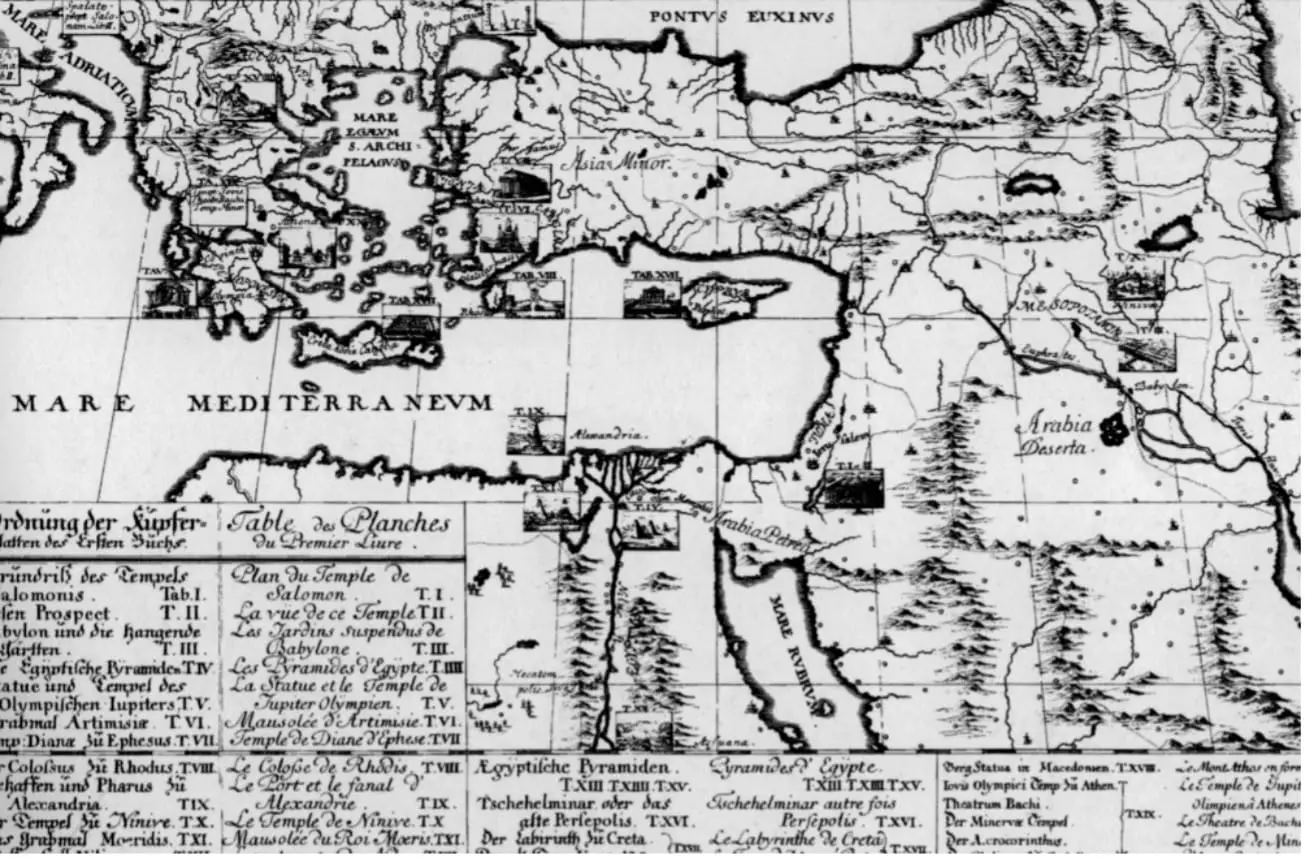
Figure 2. J. B. Fischer von Erlach, Map of the Mediterranean with the wonders of the world’s signalling, from Entwurff, 1721.
3. The journey towards the text
Concerning the treatment of the Wonders of the World, Filone da Bisanzio is the most important and detailed source from various points of view (Puppi, 1996). The text deals one by one with all seven Mirabilia. This choice makes it clear the author’s intention to build a list that appears to the reader consolidated and rigid. Although this canon has been questioned, dismembered, and recomposed over the centuries by inserting and removing many other Mirabilia, the men of the sixteenth century, in order to stabilise this choice, will refer, with some modifications, to this list by Filone, recognising its authority. On a stylistic level, there are many other novelties introduced by the text: the author reserves for each Wonder a treatment in which he tries to describe at first the methods and times of construction, the materials used, the clients, the period of reference and the physical aspect of the work and then concludes with a personal opinion, as a traveller and direct observer, which highlights the miraculous nature of the constructions. It should not be forgotten that in each paragraph, the character of fatigue in the creation of the work is underlined. This type of description opens the debate on the Art-Nature/Human-God relationship, which will be fundamental when artists, in the Renaissance period, will try to give meaning to this canon of the seven Mirabilia of Antiquity trying to propose the same greatness.
“Everyone has spoken of the Seven Wonders of the World but very few have seen them. In order to do so, it is important to go abroad, to Persia, to cross the Euphrates River, to travel to Egypt, to spend some time with the Elii in Greece, to Halicarnassus in Caria, to navigate towards Rhodes and visit the Ephesus in Ionia. Only after back-breaking trips around the whole world, can our expectations be satisfied, when years have gone by” (Clayton, Price, 1989, pp. 160-164). Philo realises that, in order to be able to admire all seven buildings, it is necessary to go on a very long trip. Man must move along the Mediterranean, from Egypt (The Pyramids and The Lighthouse in Alexandria) to Greece (Zeus from the Olympus and the Colossus in Rhodes), to the ancient Persian territory (the Mausoleum of Halicarnassus and the Temple of Phoebe and Ephesus) to then reach the banks of the Euphrates River (The Wall and Hanging Gardens of Babylonia). Augé talks of the trip as an opportunity of creating a masterpiece, of an experience favoured by disorientation; the result is that of inner dual disorientation (Augé, 2004). An ambivalence exists between an outward journey and returns, which carries an intrinsic tension between expectation (as a principle) and memory (in retrospect). The following elements are asserted at this point: image, subdivided into two categories: primary images (at the start) and memory images (which will remain in retrospect). At this point, the journey will become a sort of evaluation of reality which, in order not to disappoint, will be similar to the impression that one has of the very same journey before the departure. The Wonders, for us, simple readers, appear as “mythical events”, a great human experience as well as ephemeral (Lugli, 2006). In actual fact, they come back to life simply through retrospection, leading us to the sources like Philo from Byzantium. This concept is therefore fundamentally important for our trip to the Wonders as all the images that will be encountered are a “reproduction” or a “reconstruction” of the retrospective image that the ancient historians have conveyed, at times, in the form of a myth: “It is, therefore, a great and marvellous gift that of culture, which frees man from the need to move about and which shows him the beauties of the Earth in his home, donating eyes to his soul. It is bizarre, but he who visits a place once, the moment he leaves, forgets all about it, the perfection of a masterpiece slips away, and he forgets the details. On the contrary, he who learns about the wonder through the spoken word as well as through the accuracy of man’s enterprise, completing this very same effort as a whole, will cherish the impression of each image forever, because the soul has perceived extraordinary objects” (Clayton, Price, 1989, pp. 160-164). The physical experience of the trip is imperfect, a fleeting experience. A wise man must trust culture, an immeasurable concept that allows man to learn about the “beauties of the earth” through the spoken word. The journey pointed out by Philo to reach the Wonders created by man is an inner trip because the Wonder is nothing but the gift of the spoken word (Del Sole, 2020). This concept can be recreated and realised in time only through the spoken word: “One speaks of a journey towards the text, that is, portrayals of a mental, imaginary universe, full of meaning” (Puppi, 1996, pp. 35-36). With the spoken word, Philo introduces the itinerary that is to be followed; he describes the landscape (inner). Using very few words, the author perfectly outlines how to observe and interact with the theme relating to the Wonders of the World: “What I herewith state will appear to be true if my presentation, in its systematic description and all-inclusive of each of the seven Wonders, will be accepted by the reader encouraging him to believe he is a spectator of reality” (Clayton, Price, 1989, pp. 160-164). Philo, who recreates the memory shapes that are the essence of this journey, aims to allow the reader to travel with him along with the evocative power of the spoken word, imagination, and the desire to apprehend (the Aristotelian wonder). He talks to whoever is thirsty for culture, to whoever wants to challenge time and generations, moving along the Eastern Mediterranean in order to pursue human grandeur (culture belonging to the various Mediterranean populations symbolised by the seven Spectacula), thus providing “eyes for one’s soul”. With his text, he has created a space where you can wander in remote places while remaining closed in the silence of the pages of a book. He is a great enthusiast, hungry for knowledge, who wants to amaze readers by showing the Wonders as utopian, extraordinary pieces that he has seen after exhausting journeys. The Wonders, therefore, represent the means that man has found, through technological genius, to repropose the Art of creation of the Platonic Demiurge, proposing new models to refer to. Since Antiquity, that process of mixing and indistinguishability between Artificialia and Naturalia, both united by a pure sense of wonder (incantum), has been triggered. The seven wonders, because they escape immediate comprehension and retain a spark of divinity, appear Machines on one side and Miracula on the other. The fundamental character that has determined such a vast fortune of these archetypes is precisely their being poised between myth and reality, between utopia and architectural grandeur.
4. Conclusions: a new list of wonders to unite the Mediterranean
Kubler explains that there are interrupted, wandering or intermittent sequences depending on whether the model ceases to be reproduced or only appears on rare occasions (Eco, 2009). In the case of the Wonders, it is a sequence in progress, still in evolution today. The Wonders, imagined architectural works, remind us that the models of civilisation are in constant mutation and are anchored to what has “already worked” in the past and can therefore be re-proposed (Bolzoni, 1998). Although in 2000, during the Sydney Olympics, an attempt was made to draw up a new list of Wonders of the Modern World that could “replace” or flank the ancient one, the procedure, carried out through a web vote, had a commercial character and was devoid of historical and philological connotations. Ours is perhaps one of the most inadequate periods of wonder, in the sense that the ability to be surprised is less and less lively. The mysterious orient that has always wrapped these utopias like a veil dissolve (Brusatin, 1986). The world seems close by; everything seems easy to know. The use of information and media leads to the accumulation of data. We believe we can know everything; we can see everything and no longer need to discover anything. The global pandemic of Covid-19 in progress has helped to reverse this trend by imposing distance. The value of travel has been fully understood. Simultaneously, an essential impetus has been given to the fruition of the virtual world, which, as Filone da Bisanzio recalled many centuries ago, can propose real “journeys towards the text”, virtual journeys. We are witnessing in the contemporary world a flattening that has generated the anguish of Wonder, that feeling of falling behind our predecessors, of losing essential information. This feeling came back with great strength when the physical and mental barriers we thought were definitely overcome returned. They limit the possibilities of contact and freedom of movement. The Wonders of the World represent today (as they did yesterday) precisely this feeling, this ambivalence. In this sense, it is not difficult to understand, for example, the ideas of renewal of young Greek talents who aim to rebuild the Colossus of Rhodes to relaunch the economy of their nation or the intentions of Egyptian politicians who approved, a few years ago, a project for the reconstruction of the Lighthouse of Alexandria (fig. 3).
5. Discussion
The drafting of a canon of the Wonders of the contemporary world is a very topical project. Above all, it is the sense of universality that comes from the architectural works forming part of the ancient canon that must be sought again. The new travel in the contemporary Wonder could be understood as an itinerary in the Mediterranean, also literary and virtual as proposed by Filone da Bisanzio. This journey would allow the citizen to taste again all the potentialities of a basin that, still today, is composed of excellences in several fields, part of a single Mediterranean culture, without flags. With its sister arts, architecture has the task of recovering ancient greatness in a flattened world. The aim here is not to propose solutions but proposals. The Seven Wonders were chosen precisely because of their ability to unite and make the various souls of the ancient world, all overlooking the Mediterranean, live together peacefully. Can the contemporary Mediterranean society propose new architectural works that, like the ancient ones, can transmit the idea of a united Mediterranean thanks to the various facets of the cultures of which it is composed?
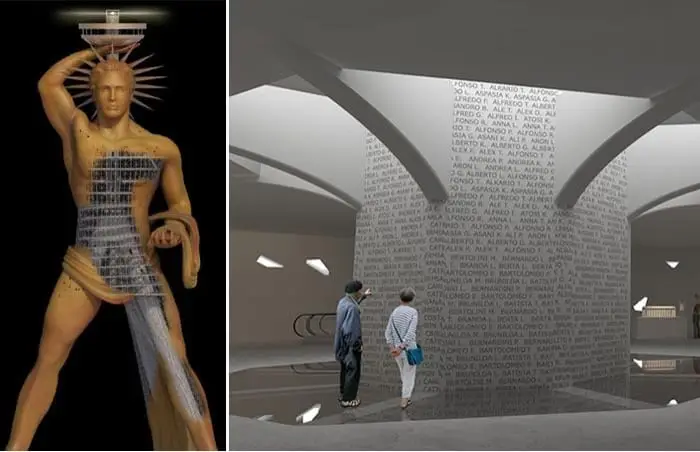
Figure 3. Reconstruction hypothesis of the Colossus of Rhodes as “Rhodes Museum” (source: http://colossusrhodes.com, 2014)
This paper has been presented at the Conference “AGORA CAUMME 2020 – Mediterranean: Between Expansion and Regeneration” and selected by the Conference Scientific Committee to be published in the SPACE International Journal of Space Studies in Architecture and Urban Design. Peer review under the responsibility of the scientific committee of AGORA CAUMME 2020.
Augé, M. (2004). Rovine e macerie [Le temps en ruines]. Turin: Bollati Beringhieri. ISBN: 9788833915166
Berti, E. (2007). In principio era la meraviglia: le grandi questioni della filosofia antica [In the beginning was the wonder: the great questions of ancient philosophy]. Bari: Laterza. ISBN: 9788858101520
Bolzoni, L. (1998). Memoria e Memorie [Memory and Memories]: Convegno internazionale di studi: Roma, 18-19 maggio 1995, Accademia Nazionale dei Lincei. Firenze: Olschki Perugia: Olschki. ISBN: 9788822246813
Brusatin, M. (1986). Arte della meraviglia [Wonder’s art]. Turin: Einaudi. ISBN: 9788806593070
Clayton, P.A. & Price M.J. (1989). Seven wonders of the ancient world. Turin: Einaudi. ISBN: 9780415050364
Del Sole, F. (2019). Viaggio nella Meraviglia: descrivere, immaginare, ri-costruire [Travel in the Wonder: describe, imagine, re-build]. Galatina: Congedo. ISBN: 9788867662302
Del Sole, F. (2020). The Gift of the Spoken Word: The Word-Image Relationship in the Memory Process. In H. A. Nia., (Ed.), New Approaches in Contemporary Architecture and Urbanism (pp. 106-114). Alanya, Antalya: Cinius Yayınları. https://doi.org/10.38027/N112020ICCAUA316283
Eco, U. (2009). La vertigine della lista [The Infinity of Lists]. Bergamo: Bompiani. ISBN: 9788845271427
Fagiolo, M. (1976). La meraviglia e il meraviglioso [Wonder and wonderful]. Psicon. Rivista internazionale di Architettura, 7(III), 3-9.
Lugli, A. (2006). Arte e Meraviglia: scritti sparsi 1974-1995 [Art and Wonder: scattered writings 1974-1995]. Turin: Allemandi. ISBN: 9788842213741
Madonna, M.L. (1976). Septem mundi miracula come templi della virtù. Pirro Ligorio e l’interpretazione cinquecentesca delle Meraviglie [Septem mundi miracula as temples of virtue. Pirro Ligorio and the sixteenth-century interpretation of Wonders]. Psicon. Rivista internazionale di Architettura, 7(III), 25-31.
Mangani, G. (2006). Cartografia morale: geografia, persuasione, identità [Moral cartography]. Modena: Panini. ISBN: 9788882908188
Meslin, M. (1988). Il meraviglioso: misteri e simboli dell’immaginario occidentale [The wonderful: mysteries and symbols of the Western imagination]. Milan: Mursia. ISBN: 9788842586401
Pontani, F.M. (Eds.) (1980). Antologia Palatina [Palatine anthology]. Turin: Einaudi. ISBN: 9788806498580
Puppi, L. (1996). I sette grandi spettacoli del mondo in margine a un testo retorico attribuito a Filone da Bisanzio [The seven wonders of the world in the margin of a rhetorical text attributed to Filone da Bisanzio]. Testo letterario e immaginario architettonico, 31-38. Milan: Jaca book. ISBN: 9788816404151
No potential conflict of interest was reported by the author(s).
Francesco Del Sole
Sign in to continue
Not a member yet? Sign up now

Administrative Assistant
Deniz Bol is the Administrative Assistant at SPACE Studies, where she supports the day-to-day operations and contributes to the smooth functioning of the organization. Alongside her administrative role, Deniz is an artist with a passion for creative expression. She is currently pursuing her studies at the University of the Arts London (UAL), where she continues to develop her artistic practice. Her organizational skills, paired with her artistic background, make her a valuable asset to the SPACE Studies team, helping bridge the worlds of administration and creativity.
E-mail: denizbol@spacestudies.co.uk
Digital Marketing Consultant
Murat Oktay is the Digital Marketing Consultant at SPACE Studies, where he provides strategic guidance to enhance our digital presence and community engagement. With a keen eye for digital marketing trends and best practices, Murat plays a key role in refining our content strategy, expanding our online reach, and connecting with a wider audience. His expertise in digital tools and innovative marketing techniques aligns with SPACE Studies’ mission as a social enterprise, ensuring that our campaigns are impactful and resonate with our commitment to social responsibility in architecture and design. Outside his work with SPACE Studies, Murat stays at the forefront of digital marketing advancements, continually exploring new tools and sharing his insights with peers.
E-mail: muratoktay@spacestudies.co.uk

Marketing Manager
Santa Noella Matabaro is the Marketing Manager of SPACE Studies, bringing her expertise in strategic planning, community engagement, and relationship-building to the organization’s mission as a social enterprise. With a background in Politics & Law from the University of Kent, Santa combines analytical insights with a creative approach to advancing SPACE Studies’ vision of fostering interdisciplinary dialogue in architecture, design, and urban planning. In her role, she develops targeted campaigns and strategic partnerships, building brand presence and fostering meaningful connections with the community. Santa’s collaborative and people-centered approach enhances SPACE Studies’ impact, aligning with its commitment to social responsibility and innovation in the built environment.
Academic Content Coordinator
Betul Uckan is an architect and dedicated academic with a background in both architectural practice and research. She holds a Master of Science in Architectural Design and a Bachelor’s degree in Architecture from Istanbul Technical University, where she cultivated her interests in architectural theory and design. Betul has gained experience as a research assistant in various universities, contributing to design studios and foundational courses. She has also worked in the field as an architect with projects focused on design, modeling, and construction, and has been involved in notable projects, including Maltepe Piazza and Emaar Square in Istanbul. With her expertise spanning both digital and material architecture, Betul brings a dynamic, interdisciplinary approach to her role as the Academic Programme Coordinator.
E-mail: betuluckan@spacestudies.co.uk
Senior Researcher & Managing Editor
Arghavan Pournaderi is a senior researcher in the field of architectural conservation and restoration, with an academic foundation in architecture and specialized expertise in historic sites and buildings. Completing her PhD at the Art University of Isfahan, Iran, in 2019, her research has contributed to the understanding of Iran’s architectural heritage, with a focus on Isfahan’s urban and architectural evolution during the Safavid period. In addition to her extensive research, Dr. Pournaderi has held academic positions at various institutions in Isfahan, teaching at both undergraduate and graduate levels. Her work extends beyond academia as she contributes to SPACE Studies as Senior Researcher & Managing Editor, where she oversees scholarly initiatives that foster deeper interdisciplinary dialogue in architecture and heritage conservation.
Senior Researcher & Educational Consultant
Gregory Cowan is a Senior Researcher and Educational Consultant at SPACE Studies, where he leads initiatives that bridge academic research and practical application in architecture and urban design. He contributes his extensive experience to mentoring postgraduate students, designing educational workshops, and guiding community-focused projects. Gregory is also a freelance academic at the University of Wales Trinity St David and the University of Westminster, and founder of The Architects Coach. His expertise spans architectural workspace analysis, professional development, and positive intelligence coaching.
E-mail: gregorycowan@spacestudies.co.uk

Senior Researcher
Alison Hand is a Senior Researcher at SPACE Studies. She is a painter and writer with an MA in Painting from the Royal College of Art. Alison’s work focuses on creating absurd, unstable heterotopic spaces and dialogues with painting history. She is currently the Artist in Residence for King’s College London Philosophy Department on the Dreams and Wakeful Consciousness Research Project, exploring themes of time and simultaneity in new work. Alison has received numerous awards for her painting and is currently working with Bloomsbury Publishers on a major essay on Drawing in Contemporary Art. She is also the BA Fine Art Programme Leader at Art Academy London and co-director of Cement Arts. Her role at SPACE Studies involves leading research projects, mentoring junior researchers, and contributing to our artistic and academic initiatives.
E-mail: alisonhand@spacestudies.co.uk
Senior Researcher
Julian Wild is a Senior Researcher at SPACE Studies and the Sculpture Program Leader at The Art Academy London. With over 30 years of experience in creating and exhibiting sculptures, Julian has worked with high-profile clients such as Cate Blanchett and the University of Oxford. A fellow and former vice president (2015-2019) of the Royal Society of Sculptors, his work has been featured at venues like Modern Art Oxford and Chatsworth House. At SPACE Studies, Julian leads research projects, mentors junior team members, and conducts workshops that blend art and urban studies. In his free time, he enjoys attending academic conferences and crafting new sculptures.
E-mail: julianwild@spacestudies.co.uk
Director of Publications & Senior Researcher
Elif Suyuk Makakli (Associative Professor) earned her PhD in Architecture from the Vienna University of Technology, where she studied the impact of technology on architecture under Prof. William Alsop. With extensive experience in architectural practice in Istanbul and Vienna, she is now an Associate Professor at FMV Isik University, focusing on design education and technology. At SPACE Studies, Elif serves as both the Head of Publications and Senior Researcher, guiding scholarly content and contributing to research initiatives. She is dedicated to mentoring and fostering design innovation.
E-mail: elifsmakakli@spacestudies.co.uk

Director of Research
Sanaz Shobeiri is an architect, urban designer, and landscape urbanist, currently a postdoctoral researcher in the Department of Planning at Queen’s University Belfast. Her research focuses on age-gender inclusiveness and the interplay of architectural, historical, political, and sociocultural dimensions in urban spaces, exemplified by her project on city centres in Belfast and Tehran. Sanaz holds a PhD in Urban Planning from the University of Tehran and has a robust portfolio in sustainability and urban theory. As Head of Research at SPACE Studies, she leads innovative research initiatives, fostering collaboration and academic excellence. In her free time, Sanaz enjoys exploring urban landscapes and supporting community development.
E-mail: sanazshobeiri@spacestudies.co.uk

Creative Director
Selin Gulce Sozmen is the Creative Director at SPACE Studies, where she leads the artistic vision and design strategy for the organisation. With a background in graphic design and visual arts, Selin has been instrumental in creating visually captivating books, journals, and event posters. Her role extends to developing and coordinating workshops and creative projects, ensuring that all visual materials meet the highest standards of quality and innovation. Selin’s dedication to creativity and excellence drives the visual and creative direction of SPACE Studies, making her an essential part of the team.
E-mail: selinsozmen@spacestudies.co.uk
Founder & Executive Director
Pinar Engincan is the Founder and Executive Director of SPACE Studies, an innovative social enterprise focused on fostering interdisciplinary dialogue and education in architecture and urban design. With extensive experience as a lecturer and researcher, Pınar holds a PhD in Architecture and has led numerous academic initiatives. Her career includes curriculum development, international collaborations, and research on housing and urban policies. Passionate about bridging academia and community, she champions accessible education and consultancy services, empowering individuals to shape the built environment.
E-mail: pengincan@spacestudies.co.uk