
A research paper may present a compelling question, carefully gathered evidence and a well-developed analysis, yet still leave readers uncertain about what the research has established. This often happens when the conclusion simply repeats the findings rather than explaining their significance.
Writing an effective conclusion requires more than summarising the research. It involves bringing the central argument together, demonstrating the contribution of the study and acknowledging the boundaries of its findings. As Booth, Colomb and Williams (2008, pp. 244–245) emphasise, a conclusion should return to the central argument while helping readers understand why it matters.
As Tablas-Mejia (2021) explains in the San José State University Writing Center handout, a conclusion should do more than summarise a paper: it should help readers understand the significance of the research. Although the structure of a conclusion varies across disciplines and publication formats, its underlying purpose remains consistent: to communicate what the research has established, why it matters and what can reasonably be concluded from the evidence.
What Should a Research Paper Conclusion Do?
A research paper conclusion brings the central argument to a close by answering the research question and explaining the significance of the findings. Rather than repeating individual results, it draws together the most important insights and shows how they contribute to the wider field of research.
Depending on the nature of the study, the conclusion may also acknowledge limitations, consider implications or identify questions that remain unanswered. These elements should strengthen the overall argument without introducing new evidence or reopening the discussion.
Discussion and Conclusion: What Is the Difference?
Although closely related, the discussion and conclusion serve different purposes in a research paper.
The discussion is where researchers examine their findings in depth. They interpret the results, consider alternative explanations, compare their findings with existing literature and address methodological limitations. The conclusion, by contrast, brings these interpretations together to communicate the study’s central argument and contribution.
In papers with a separate discussion section, the conclusion is often relatively brief. It should answer the research question and leave readers with a clear understanding of what the study contributes. However, some disciplines and journals combine the discussion and conclusion into a single section. Researchers should therefore consider the conventions of their discipline and the requirements of their chosen publication.
Six Principles for Writing an Effective Research Paper Conclusion
Writing a strong conclusion involves several decisions, from identifying the most important findings to explaining their wider significance. The following six principles provide practical guidance for bringing these elements together while maintaining a clear connection to the research question.
About the Hypothetical Research Example
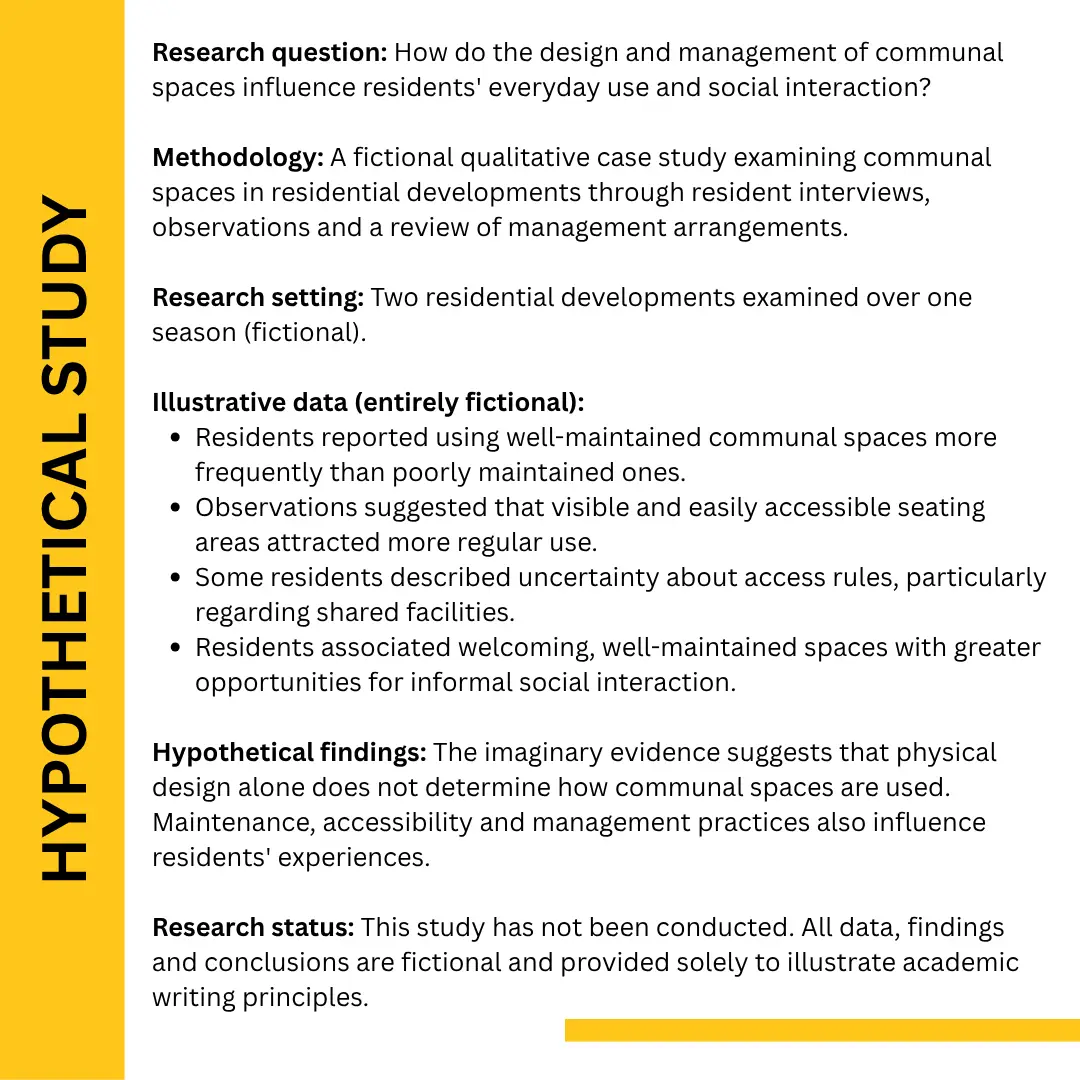
Throughout the following sections, we use a hypothetical study exploring how the design and management of communal spaces influence residents’ everyday use and social interaction.
The study is entirely fictional. No research has been conducted, and the findings and conclusions presented are invented solely for illustrative purposes. They are used to demonstrate different approaches to writing a research paper conclusion and should not be interpreted as actual research evidence.
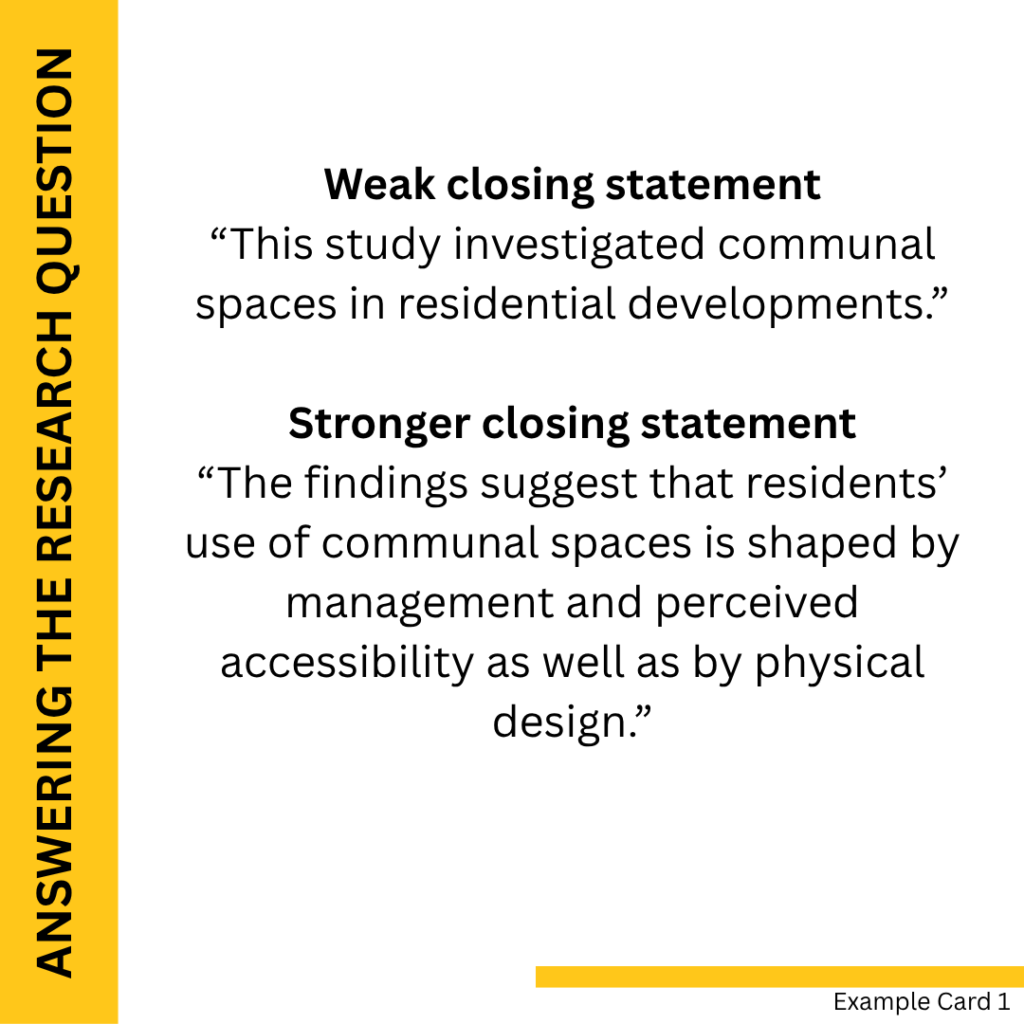
1. Return To The Research Question — With An Answer
A conclusion should return to the question that guided the research, but simply restating the original aim is not enough. Readers need to understand what the study has established in relation to that question. An answer may be qualified, especially where findings are mixed or context-dependent, but it should not leave readers to reconstruct the argument for themselves.
To check your conclusion, place the research question beside your closing paragraph. Does the paragraph answer it, or merely describe the topic and methods? If the question has several parts, consider whether each has been addressed in proportion to the evidence.
Example Card 1 shows the difference. The weaker statement describes what was investigated; the stronger statement identifies what the hypothetical findings suggest. Its wording matters too: “suggest” acknowledges uncertainty, while “prove” would imply more certainty than the evidence may justify.
A useful conclusion does not need to be definitive. If the research cannot fully answer its original question, state what it can establish and what remains unresolved. The strength of the answer should follow from the evidence, not the writer’s desire for a decisive ending.
2. Synthesise Your Findings Instead of Listing Them
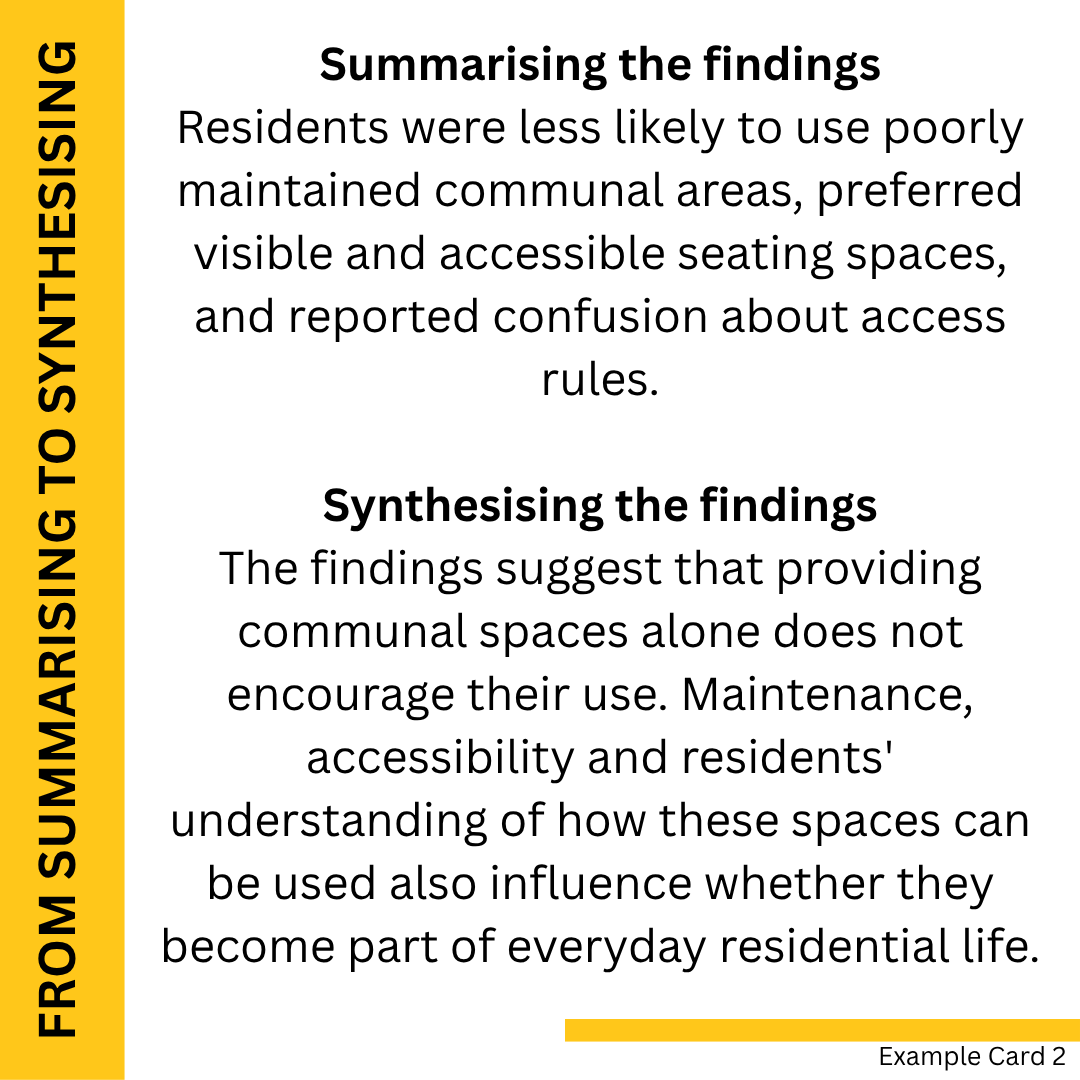
The results section presents what the research has found. A conclusion should do more than repeat those findings: it should show how the most important results relate to one another and what they mean for the central argument. This is synthesis, and it often requires leaving less relevant details behind.
A useful starting point is to ask what the findings reveal when read together. Do they point to a shared explanation, expose a tension or suggest that an initial assumption needs revising? The aim is not to make every result fit one neat message. Contradictory or unexpected findings may be central to the contribution and should not be concealed.
Example Card 2 illustrates the difference. The first version lists observations about maintenance, seating and access rules. The second draws out a broader relationship: providing communal space is not, by itself, enough to ensure that residents use it. The conclusion becomes more informative because it connects the observations without treating them as proof of a universal rule.
When revising, identify the two or three findings that most directly answer your research question. Then ask what you can reasonably say about their relationship. If your synthesis introduces an idea not developed in the discussion, it may need further support before it belongs in the conclusion.
3. Explain Your Contribution Without Exaggeration
A research paper should leave readers with a clear understanding of what it contributes to existing knowledge. This does not require a claim of originality on a grand scale. A contribution might lie in questioning an assumption, connecting previously separate concerns, offering a different interpretation of evidence or examining a familiar problem in a new setting.
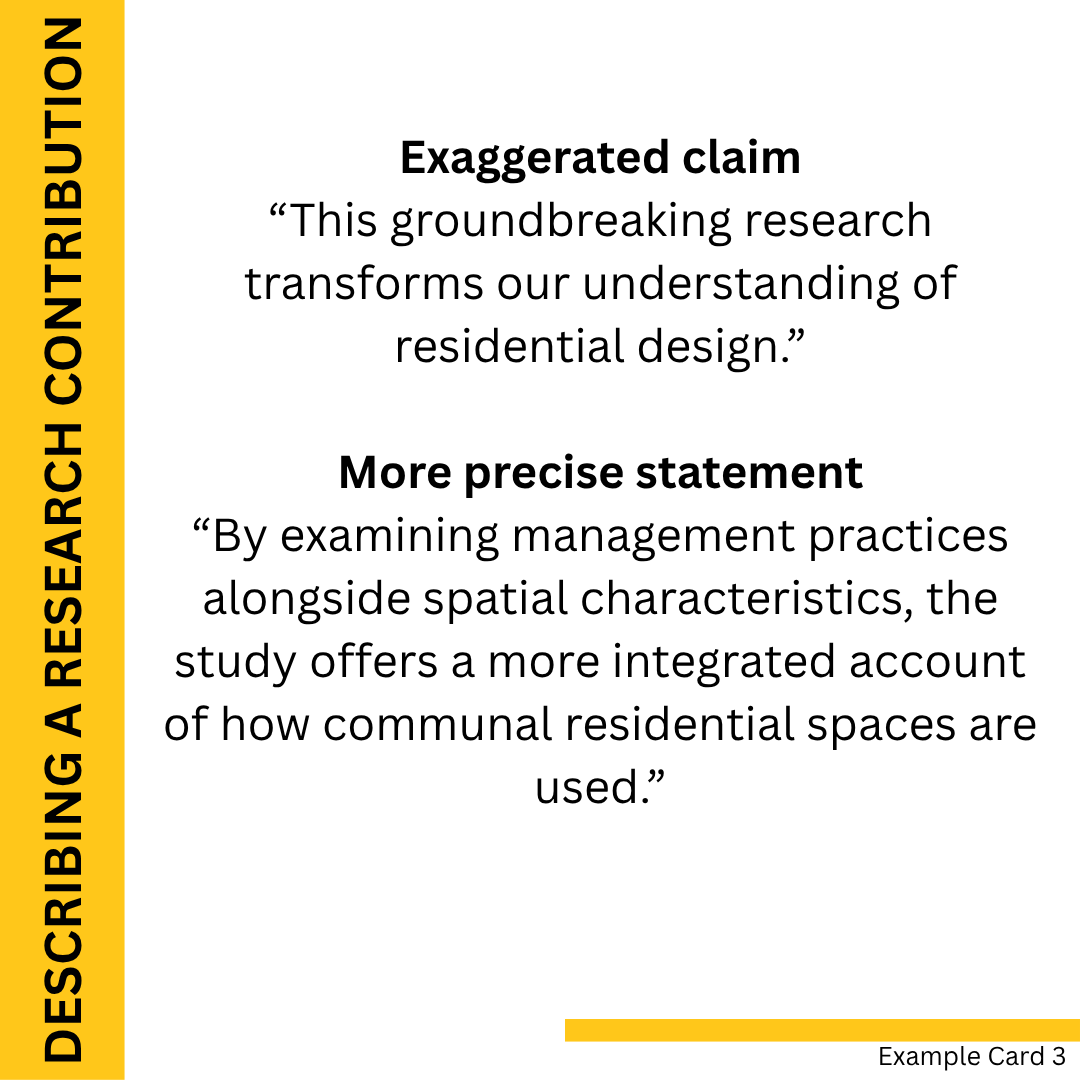
To explain a contribution convincingly, identify what the study adds and to which conversation it adds it. A conclusion should distinguish between what the evidence establishes and what the researcher hopes its wider influence might be. Claims such as “revolutionary” or “groundbreaking” rarely help readers make that judgement.
Example Card 3 contrasts an exaggerated claim with a more precise statement. The stronger version identifies the relationship between management practices and spatial characteristics as the study’s contribution. It gives readers something specific to assess rather than asking them to accept a declaration of importance. When revising your conclusion, try completing the sentence “This study contributes by…” and check that the answer is supported by your analysis.
4. Acknowledge Limitations Without Undermining the Study
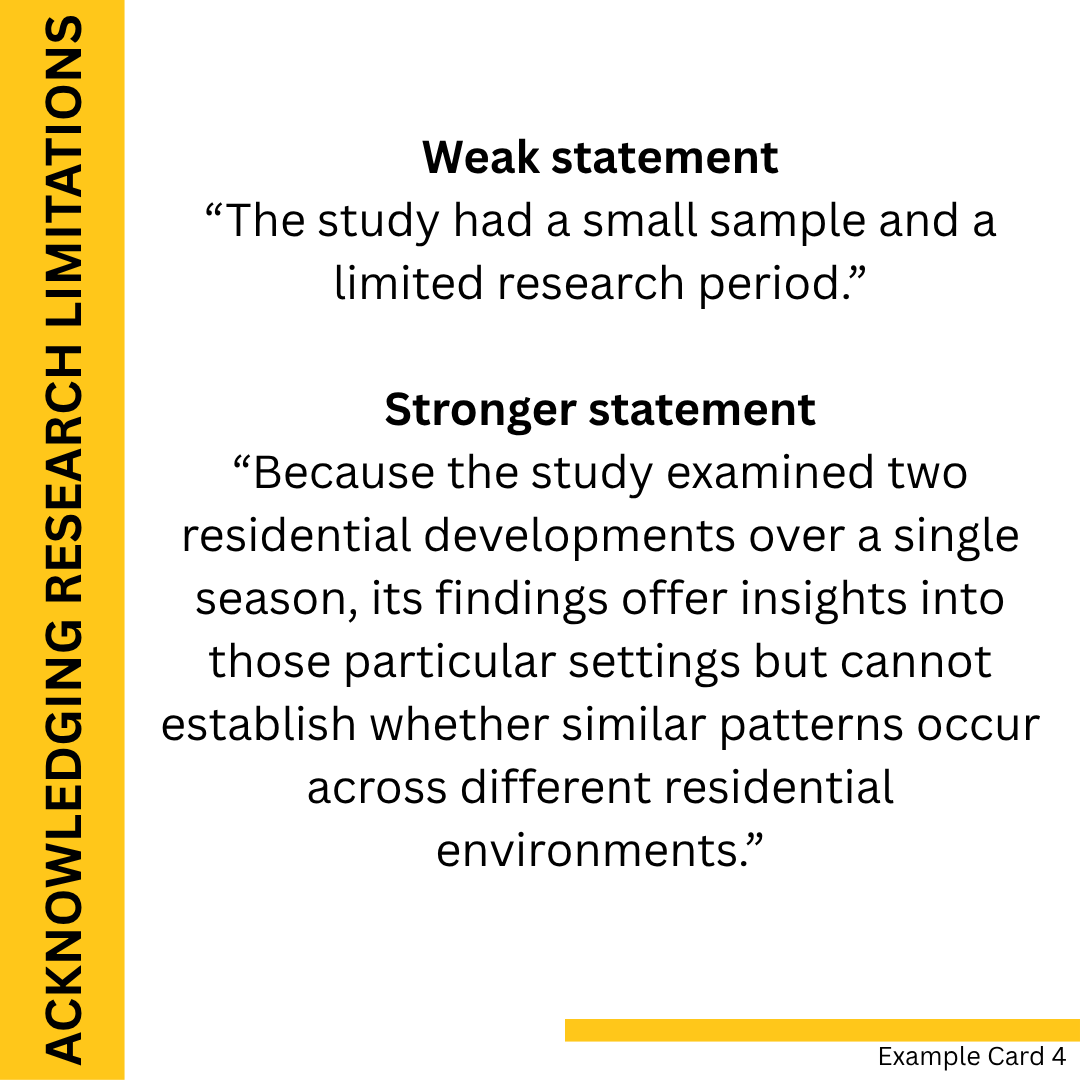
Every research study has boundaries. These may arise from its methodology, the size or characteristics of its sample, the geographical or historical context, or the period during which data were collected. Acknowledging these limitations does not diminish the value of the research. Instead, it helps readers understand the conditions under which its findings can reasonably be interpreted.
The important distinction is between identifying a limitation and explaining its implications. Simply stating that a study involved a small sample, for instance, tells readers relatively little. Researchers should consider how that sample influences the scope of their conclusions. Does it restrict the possibility of generalisation? Does it limit the range of perspectives represented? Or does it leave particular questions unanswered?
Example Card 4 illustrates this distinction through our hypothetical study of communal spaces. The stronger statement does more than acknowledge the limited research setting. It explains why the findings should be interpreted in relation to the particular developments examined rather than applied automatically to all residential environments.
Researchers should also distinguish between limitations that affect the central argument and those already addressed elsewhere in the paper. If the discussion section examines methodological limitations in detail, the conclusion needs only to revisit those that directly influence its final claims.
The aim is not to catalogue everything the study could not achieve, but to define clearly what its evidence allows us to conclude.
5. Identify Implications and Future Research That Follow from the Evidence
A research paper should help readers understand why its findings matter beyond the immediate study. This may involve considering implications for theory, professional practice, policy or future research. However, not every study needs to produce practical recommendations. Some make their most important contribution by questioning an established interpretation, refining a concept or identifying an issue that requires further investigation.
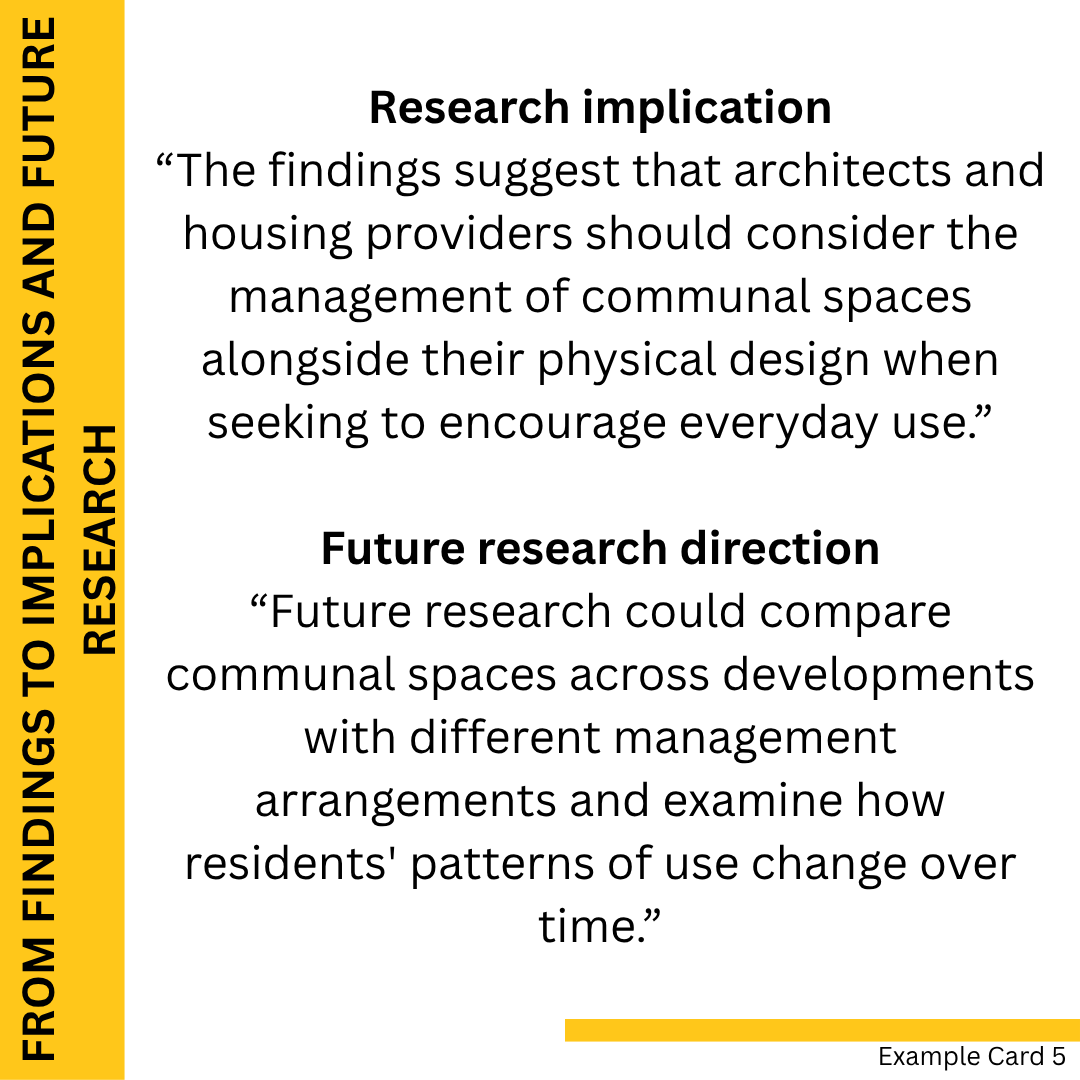
Research implications concern what the findings may mean for a wider field of knowledge or practice. In our hypothetical study, the relationship between management arrangements and residents’ use of communal spaces could have implications for architectural design and housing management, as illustrated in Example Card 5. However, implications must remain proportionate to the evidence. A study conducted in a limited number of settings cannot establish that the same relationships will occur everywhere.
Future research recommendations, by contrast, identify questions that the study could not fully address. These may arise from its limitations, unexpected findings or relationships that deserve closer examination. Booth et al. (2008, p. 245) highlight the importance of recognising questions that remain unanswered, allowing research to contribute to an ongoing scholarly discussion.
Example Card 5 also illustrates how a future research direction can follow from the study’s findings and limitations. Rather than simply stating that further investigation is necessary, it identifies what could be examined next. When writing this part of a conclusion, researchers should ask whether their implications and recommendations genuinely follow from the evidence. Avoid ambitious proposals that the study has not established or a long list of loosely related possibilities.
A well-considered conclusion identifies where the findings may lead without claiming more than the research can support.
6. Find a Final Sentence That Earns Its Place
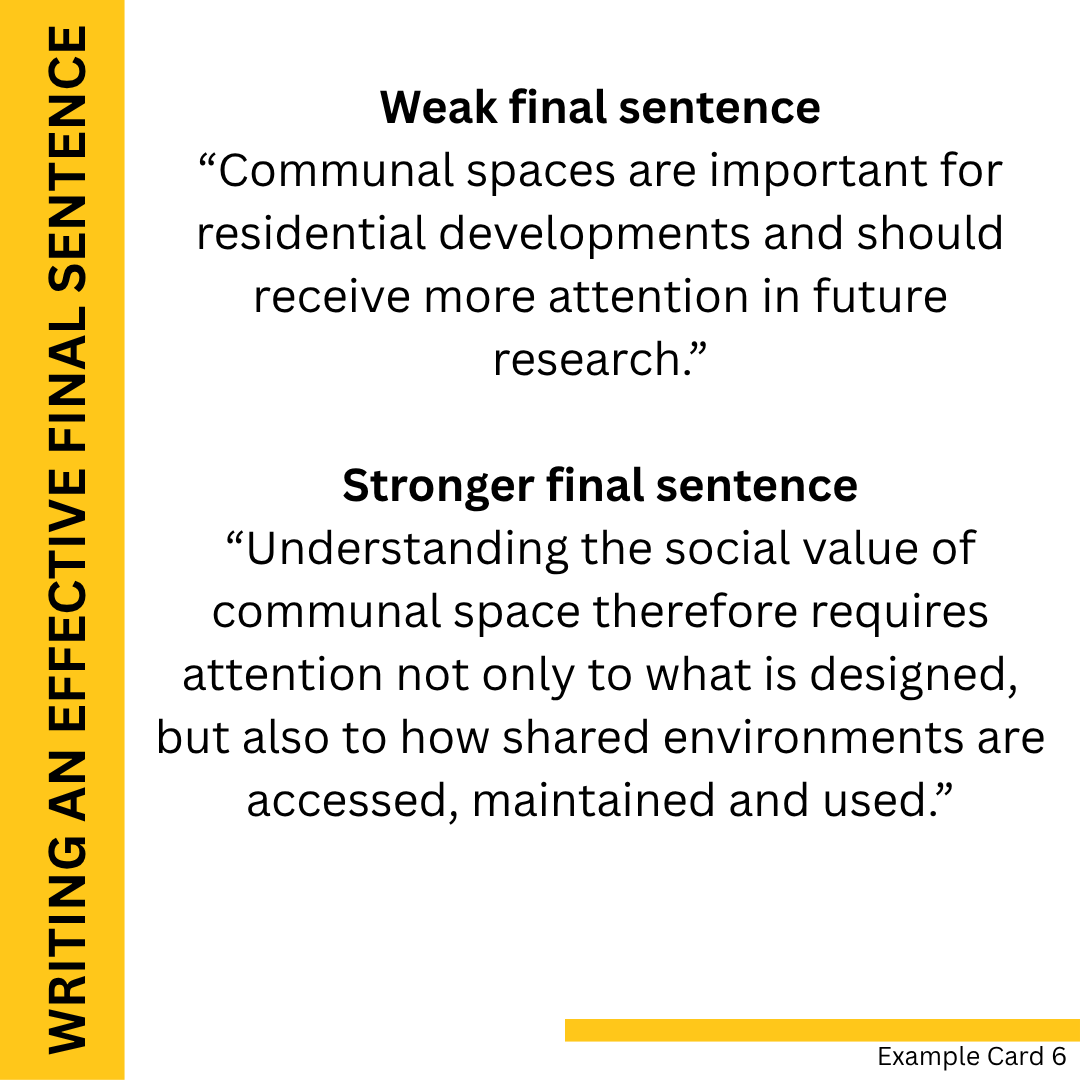
The final sentence of a research paper deserves careful attention. Although it may be only a small part of the conclusion, it shapes the impression readers take away from the study. An effective ending should reinforce the central argument without repeating the research question, introducing new evidence or making claims that extend beyond the findings.
There is no single formula for writing a strong final sentence. Some papers end by emphasising their principal contribution, while others highlight an implication or a question that remains open. The most appropriate approach depends on the nature of the research and the conventions of the discipline.
One useful technique is to return to an idea introduced at the beginning of the paper. Booth et al. (2008, p. 247) discuss how revisiting an earlier idea or image can create a sense of coherence. However, this should not become a purely stylistic exercise. The closing statement must still communicate something meaningful about what the research has established.
Example Card 6 illustrates how a final sentence can move beyond a general statement about the importance of a subject. In our hypothetical study, the stronger version brings together the relationship between physical design, accessibility and management practices. It leaves readers with the study’s central insight rather than simply reminding them that communal spaces matter.
When revising your final sentence, consider whether it could appear unchanged at the end of almost any paper on the same topic. If so, it may be too general. A more effective ending should reflect the particular argument and contribution of your research.
Above all, avoid the temptation to finish with an exaggerated claim or an inspirational statement disconnected from the evidence. The purpose of the final sentence is not to impress readers with its language, but to leave them with a clear understanding of what the research contributes.
A Worked Example: Bringing the Six Principles Together
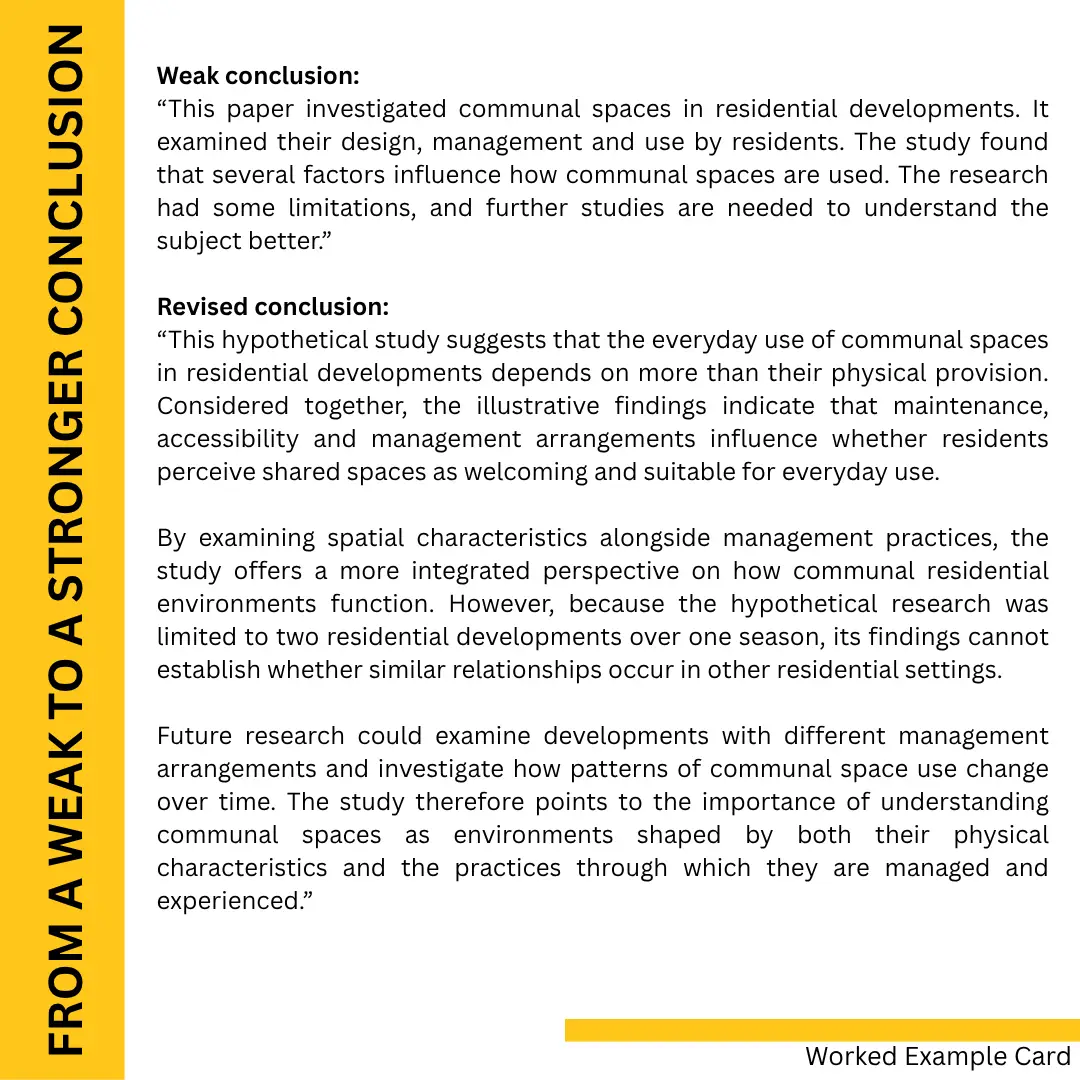
Writing an effective conclusion involves bringing individual techniques together into a coherent closing argument without repeating the discussion or introducing new evidence. The following worked example draws on our fictional study of communal residential spaces.
Why the Revised Conclusion Is More Effective
The difference between the two conclusions is not simply a matter of length or more sophisticated language. The revised version demonstrates how a conclusion can develop a coherent argument from the findings rather than merely report that research has been conducted.
First, it answers the research question. The weak conclusion tells readers what the paper investigated but provides little indication of what was learned. The revised version immediately establishes the central insight: the use of communal residential spaces depends on more than their physical provision. This gives readers a clear answer to the question underlying the hypothetical study.
Second, it synthesises the findings. Rather than listing maintenance, accessibility and management as separate observations, the revised conclusion brings them together to explain how residents experience communal spaces. This is an important distinction. A conclusion should help readers understand the relationships between findings and what those relationships suggest about the wider research problem.
Third, it identifies a contribution without exaggeration. The revised conclusion does not claim to have discovered a universal principle of residential design. Instead, it identifies the value of examining spatial characteristics alongside everyday management practices. This is a more specific and defensible contribution, grounded in the hypothetical findings.
Fourth, it acknowledges the boundaries of the research. By referring to the two residential developments and the single-season research period, the conclusion makes clear that its findings cannot automatically be applied to other residential settings. These limitations do not invalidate the study; they help readers understand the conditions under which its conclusions should be interpreted.
Fifth, it proposes a meaningful direction for future research. The recommendation to investigate developments with different management arrangements and examine changes over time follows directly from the study’s findings and limitations. It is more useful than the generic suggestion that further research is needed because it identifies specific questions worth investigating.
Finally, it ends with a clear central insight. Rather than closing with a broad statement about the importance of communal spaces, the revised conclusion reinforces the relationship between physical environments and the practices through which those environments are managed and experienced.
Taken together, these changes demonstrate that an effective conclusion is not a compressed version of the entire paper. It is a carefully constructed argument that brings the research to a meaningful close. The aim is to help readers understand what has been established, why it matters and how far the evidence allows the researcher to go.
Writing a Conclusion That Gives Your Research Meaning
An effective research paper conclusion does more than signal that the discussion has ended. It brings the different parts of the research together and helps readers understand what the study has established.
Writing this section requires judgement. Researchers must decide which findings deserve emphasis, how their contribution should be expressed and where the boundaries of their claims lie. A conclusion that attempts to include everything may obscure the central argument, while one that makes exaggerated claims can weaken the credibility of otherwise valuable research.
The strongest conclusions are not necessarily the longest or most ambitious. They are those that communicate the significance of the research with clarity, precision and appropriate confidence.
Ultimately, a conclusion is where the researcher takes responsibility for the argument: explaining what the evidence supports, acknowledging what remains uncertain and showing how the work contributes to a wider conversation.
A Final Revision Check
Before submitting your paper, use these six questions to review your conclusion:
- Does it answer the research question rather than merely restate the topic?
- Does it synthesise the main findings instead of listing results?
- Is the contribution to knowledge specific and supported by the evidence?
- Are the limitations acknowledged without overstating or undermining the findings?
- Do the implications and future research directions follow logically from the study?
- Does the final sentence reinforce the central insight without introducing new information?
As a final exercise, read your conclusion on its own. Could a reader understand what the study establishes, why it matters and how far its claims extend? Then read the introduction and conclusion together: they should address the same research problem, but the conclusion should show what has been learned.
Put Your Conclusion Writing into Practice
To help you review your own conclusion, SPACE Studies has prepared a one-page Research Paper Conclusion Checklist that you can download and use while writing or revising your paper.
If you would like more detailed guidance, our Research Paper Conclusions: A Practical Writing Toolkit takes you through the writing process with explanations, worked examples and practical exercises designed to help you develop your own conclusion.
For a more interactive learning experience, join our Research Paper Conclusion Writing Workshop, where we explore effective writing strategies, examine practical examples and guide you through developing and refining your own research conclusion. The workshop is offered regularly, providing opportunities to participate at a time that suits you.
For those seeking personalised guidance, SPACE Studies also offers one-to-one mentorship sessions tailored to each participant’s individual needs and goals. Whether you are working on a research paper, developing an academic project or seeking professional guidance, our mentorship programme provides an opportunity to receive focused support and constructive feedback. Sessions can also be dedicated to developing and refining your research paper conclusion.
References
Booth, W. C., Colomb, G. G., & Williams, J. M. (2008). The craft of research (3rd ed.). University of Chicago Press. https://doi.org/10.7208/chicago/9780226062648.001.0001
Creswell, J. W. (2014). Research design: Qualitative, quantitative, and mixed methods approaches (4th ed.). SAGE Publications. https://study.sagepub.com/creswellrd4e
Tablas-Mejia, I. (2021). Conclusion section for research papers [Handout]. San José State University Writing Center. https://pdp.sjsu.edu/writingcenter/docs/handouts/Conclusion%20Section%20for%20Research%20Papers.pdf
Further Reading
Scribbr. (n.d.). Research paper conclusion. https://www.scribbr.com/research-paper/research-paper-conclusion/
Sheffield Hallam University. (n.d.). Conclusions. https://libguides.shu.ac.uk/researchprojects/conclusions
The University of Manchester. (n.d.). Writing conclusions. Academic Phrasebank. https://www.phrasebank.manchester.ac.uk/writing-conclusions/
University of Oxford. (n.d.). Writing conclusions. https://lifelong-learning.ox.ac.uk/writing-conclusions/